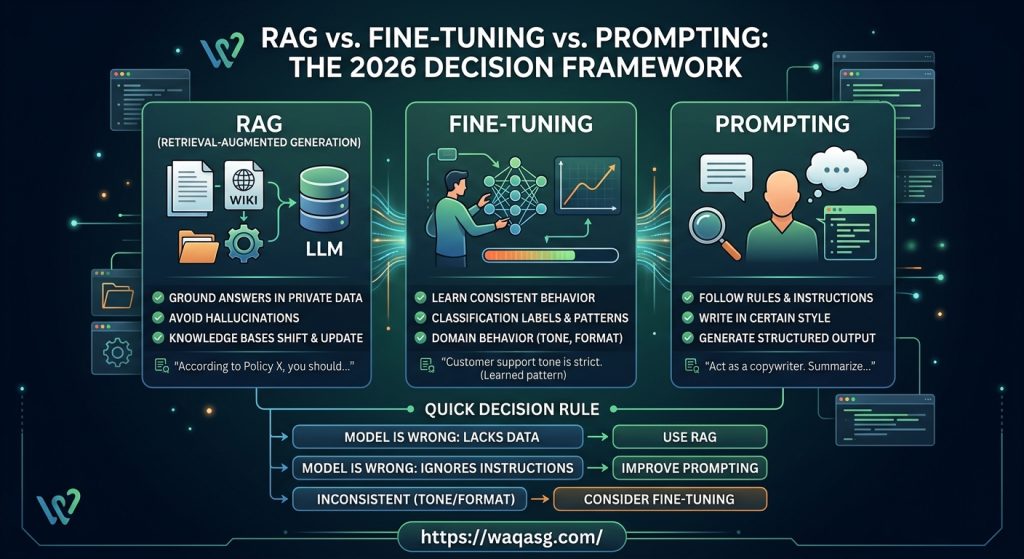
RAG vs. Fine-Tuning vs. Prompting in 2026: The No-Nonsense Guide for AI Builders
If you’re building an AI app right now—whether it’s a customer support bot, an internal copilot, or a smart search tool—you are guaranteed to hit this exact crossroads:
Should I just write a better prompt, spin up a RAG pipeline, or bite the bullet and fine-tune a model?
The developer community loves to overcomplicate this debate. Let’s cut through the noise. Here is the reality in 2026:
- Prompting is your fastest path to actual value.
- RAG is your go-to for fresh, private, or factual data.
- Fine-tuning is your weapon for consistent behavior at scale (assuming you have the data to back it up).
Here is a plain-English breakdown of when each approach actually wins, plus a deployment checklist you can take straight to your next sprint planning.
The Big Three: Quick Definitions
1. Prompting (The Baseline)
You give the model explicit instructions, rules, and maybe a few examples right inside the prompt.
- When to use it: You want the model to adopt a specific persona, follow a set of rules, or output a basic structured format. Start here. Always.
2. RAG (Retrieval-Augmented Generation)
You retrieve relevant text from your own shifting data sources (policies, wikis, live databases) and inject it into the prompt so the model has the right context before it answers.
- When to use it: The model needs to ground its answers in your specific, evolving knowledge base to avoid hallucinating.
3. Fine-Tuning (The Behavior Shaper)
You train the model on a curated dataset so it bakes in specific patterns, tones, or classification logic at a fundamental level.
- When to use it: You need massive consistency, lower latency at scale, or highly niche domain behavior that prompting just can’t reliably enforce.
The Golden Rule for Decision Making
If you only bookmark one thing from this post, make it this framework:
- If the model is failing because it lacks your proprietary data → Build RAG.
- If the model is failing because it ignores your instructions → Improve your Prompting.
- If the model gets it right sometimes, but is annoyingly inconsistent with its tone or format → Look into Fine-Tuning.
What I’d Choose in the Real World
Let’s look at some actual production scenarios and how to solve them:
- Scenario A: “I need a bot to answer HR questions from our company PDFs.”
- The Pick: RAG. The truth lives in those documents, and HR policies change. Fine-tuning on a PDF that will be outdated next month is a trap.
- Scenario B: “I need to turn messy user feedback into perfectly formatted Jira tickets.”
- The Pick: Prompting first, Fine-Tuning later. Modern models can handle formatting via prompting. But if you are processing thousands of tickets a day and need 99.9% structural reliability, fine-tune it.
- Scenario C: “A customer-facing assistant that absolutely cannot hallucinate.”
- The Pick: RAG + Guardrails. RAG forces the model to cite your trusted sources, while programmatic guardrails ensure it gracefully refuses to answer things it shouldn’t.
- Scenario D: “I need to route incoming emails into 12 distinct support categories.”
- The Pick: Fine-Tuning (or a traditional small classifier). Classification requires stable, repeatable decisions. This is fine-tuning’s bread and butter.
The Hard Truth About RAG
A lot of teams still think RAG just means “dumping your docs into a vector database.” That is the easy part. The things that will actually break your app in production are:
- Chunking: How you slice your text. Too small, and the model loses context. Too big, and you introduce irrelevant noise.
- Retrieval Quality: Can your system actually grab the right paragraph out of 10,000 pages?
- Evaluation: How are you mathematically proving the model’s answer matches the retrieved text?
The “Day One” RAG Checklist
If you’re building RAG this week, don’t over-engineer it. Start here:
- Clean your data: Strip out nav bars, messy HTML, and repeated footers.
- Chunk by meaning: Split by headings and sections, not arbitrary character counts.
- Keep the metadata: Always store the source URL, update date, and section title.
- Limit the context: Only feed the model the top 3 to 5 retrieved chunks.
- Lock it down: Explicitly prompt the model to only use the provided text, and to say “I don’t know” if the answer isn’t there.
When Fine-Tuning is Actually Worth the Headache
Fine-tuning is expensive and time-consuming. It is a terrible solution for fixing a knowledge gap, but it is an incredible tool when:
- You have hundreds (or thousands) of high-quality examples of the perfect output.
- You need to force a strict, predictable output format for an API to consume.
- You need the model to adopt a highly specialized tone (like legal or medical compliance) perfectly, every single time.
The 2026 Developer Workflow
If you are spinning up a new AI feature today, here is the exact order of operations to keep your team moving fast without building tech debt:
- Start with Prompting: Get immediate feedback and validate the use case.
- Add RAG: Do this the second you realize the model needs access to private or changing data.
- Consider Fine-Tuning: Bring this in only when you hit scale and need to ruthlessly optimize for consistency, speed, or token costs.
- Evaluate Early: Build a small test set of 50-100 queries on day one. Stop guessing if your tweaks are working; measure them.
Final Thoughts
Does RAG replace fine-tuning? No. RAG brings the knowledge; fine-tuning shapes the behavior. They are incredibly powerful when combined.
Is prompt engineering dead? Not even close. Models are smarter, but garbage in still equals garbage out. Clear instructions and solid architecture still win.
What are you building right now? Drop a comment below with your use case (chatbot, semantic search, workflow automation) and what your data looks like. Let’s map out your architecture together.